

In today’s competitive digital market, having a website is not enough. Your business needs to appear when potential customers search for your products or services on Google. A higher position in search results can help your business gain more visibility, attract relevant visitors, and generate more opportunities. This is where SEO techniques for business become important.
Search Engine Optimization (SEO) is a long-term digital marketing strategy that helps search engines understand your website and helps users discover your business through relevant searches. By implementing the right SEO techniques for business, companies can improve their website performance, increase organic traffic, and build a stronger online presence.
But how can you increase Google rankings?
SEO techniques for business
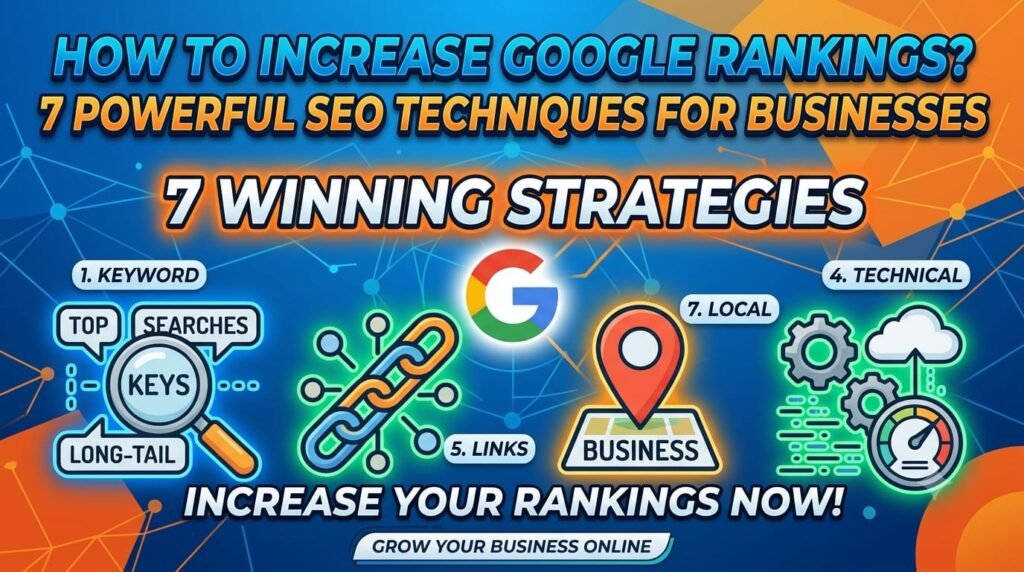
1. Perform Strategic Keyword Research
Keyword research is the foundation of a successful SEO strategy.
Before creating or optimizing website content, businesses need to understand what their target customers are searching for on Google.
An effective keyword research process identifies:
- Relevant business keywords
- Commercial keywords
- Informational keywords
- Local keywords
- Long-tail keywords
- High-intent search terms
- Industry-specific keywords
For example, a business offering SEO services could target keywords such as SEO techniques for business, SEO services, business SEO services, SEO company, and SEO strategy for businesses.
Long-tail keywords can also help businesses target more specific searches. Examples include:
- Best SEO techniques for business
- SEO techniques for small businesses
- Effective SEO strategy for business growth
- How to improve Google rankings for business websites
The goal is not to add keywords everywhere. Instead, keywords should match the search intent of your potential customers and be used naturally throughout the website.
2. Optimize Your Website With On-Page SEO
On-page SEO is one of the most important SEO techniques for business websites.
It involves optimizing individual website pages so search engines can better understand the content and users can easily find the information they need.
Important on-page SEO elements include:
- SEO title
- Meta description
- H1, H2 and H3 headings
- URL structure
- Keyword placement
- Internal links
- Image alt text
- Content structure
- Search intent
- Readability
For example, if your target keyword is SEO techniques for business, the phrase can be naturally included in the page title, introduction, relevant headings, and supporting content.
However, avoid keyword stuffing.
Google’s goal is to provide users with useful and relevant search results. Therefore, your content should be written primarily for people while making it easy for search engines to understand the topic.
3. Create High-Quality, Search-Intent-Focused Content
Content plays a major role in modern SEO.
Businesses should create content that answers the questions their potential customers are asking.
Instead of publishing articles simply to add keywords, develop content that provides genuine value.
A strong SEO content strategy can include:
- Blog posts
- Service pages
- Product pages
- FAQs
- How-to guides
- Case studies
- Industry guides
- Comparison articles
- Location-based content
For example, a business targeting SEO techniques for business can create an informative article explaining how different SEO methods can improve Google visibility.
Content should satisfy the user’s search intent.
If someone searches for “how to increase Google rankings,” they expect practical information rather than a page filled with promotional content.
Useful content can attract organic traffic, build credibility, support internal linking, and create more opportunities to convert visitors into customers.
4. Improve Technical SEO and Website Performance
Even excellent content may struggle to perform if your website has technical problems.
Technical SEO helps search engines crawl, understand, and index your website effectively.
Important technical SEO activities include:
- Improving page speed
- Mobile optimization
- Fixing broken links
- Creating XML sitemaps
- Optimizing robots.txt
- Managing redirects
- Fixing indexing issues
- Implementing canonical tags
- Improving Core Web Vitals
- Securing the website with HTTPS
Website speed and mobile usability are also important for user experience.
If visitors struggle to access or navigate your website, they may leave quickly.
Therefore, technical SEO should be an important part of your overall SEO techniques for business strategy.
A technically healthy website provides a stronger foundation for content, keywords, and other SEO activities.
5. Build Relevant and High-Quality Backlinks
ff-page SEO is another important component of SEO techniques for business.
Backlinks are links from other websites pointing to your website. Relevant, trustworthy backlinks can help strengthen your website’s authority and improve its ability to compete in search results.
Businesses can work toward earning quality backlinks through:
- Guest contributions
- Industry publications
- Digital PR
- Business directories
- Relevant citations
- Resource pages
- Original research
- Valuable shareable content
However, the focus should be on quality and relevance rather than simply collecting a large number of links.
Hundreds of irrelevant or low-quality backlinks may not provide the same value as a smaller number of relevant, authoritative links.
A sustainable off-page SEO strategy should prioritize genuine relevance, useful content, and natural link acquisition.
6. Use Local SEO to Improve Regional Visibility
If your business serves customers in a specific city, state, or region, local SEO can be one of the most effective SEO techniques for business growth.
Customers frequently search for businesses using location-based phrases such as:
- SEO company near me
- SEO services in Tamil Nadu
- digital marketing agency in Madurai
- best SEO company in India
- website development company near me
Optimizing your local online presence can help your business reach customers who are actively looking for your services.
Local SEO activities can include:
- Google Business Profile optimization
- Local keyword optimization
- Customer review management
- Local citations
- Location pages
- NAP consistency
- Local backlinks
- Location-focused content
For businesses with physical locations or specific service areas, local SEO can improve visibility among nearby customers.
7. Monitor SEO Performance and Keep Optimizing
SEO is not a one-time task.
Google search results continuously change, competitors publish new content, customer search behavior evolves, and websites require ongoing improvements.
That is why monitoring performance should be part of every SEO strategy for businesses.
Businesses can track important SEO metrics such as:
- Organic traffic
- Keyword rankings
- Search impressions
- Click-through rate
- Website conversions
- Leads
- Indexed pages
- Backlinks
- Local search visibility
- User engagement
Tools such as Google Search Console and Google Analytics can provide valuable insights into website performance.
For example, if a page receives many impressions but very few clicks, the title and meta description may need improvement.
If a page receives traffic but does not generate enquiries, the content or call-to-action may need optimization.
Continuous analysis allows businesses to identify opportunities and improve their SEO strategy over time.
Why Are SEO Techniques Important for Businesses?
Implementing the right SEO techniques for business can provide benefits beyond improving keyword rankings.
A strong SEO strategy can help businesses achieve:
- Better Google visibility
- Increased organic traffic
- More qualified website visitors
- Stronger online credibility
- Improved local visibility
- More leads and enquiries
- Better user experience
- Long-term digital marketing value
Unlike short-term promotional campaigns, SEO can continue generating organic visibility when a website maintains strong content and technical foundations.
However, SEO results are not instant. The timeline can vary depending on industry competition, website authority, content quality, technical health, backlinks, and the keywords being targeted.
How Can an SEO Company Help?
Implementing SEO techniques for business requires research, planning, execution, and continuous monitoring.
An experienced SEO company can help businesses with:
- Keyword research
- SEO audits
- On-page SEO
- Technical SEO
- Content strategy
- Local SEO
- Link building
- Competitor analysis
- Google ranking monitoring
- SEO reporting
Instead of using a one-size-fits-all approach, an SEO professional can develop a strategy based on the business’s industry, target audience, location, competition, and growth goals.
Final Thoughts
Increasing Google rankings requires more than adding keywords to your website. Businesses need a complete and consistent SEO strategy that combines keyword research, on-page optimization, valuable content, technical SEO, quality backlinks, local SEO, and continuous performance monitoring.
These 7 SEO techniques for business can help create a stronger foundation for improving search visibility and attracting potential customers through organic search.
If your business wants to increase online visibility, improve Google rankings, and generate more qualified traffic, start by evaluating your current SEO strategy and identifying the areas that need improvement.
With the right SEO techniques for business, consistent execution, and continuous optimization, your website can build stronger search visibility and create more opportunities for long-term business growth.