

In today’s digital world, having a website is not enough to attract customers. Small businesses need to make sure their website can be found when potential customers search for products or services online. This is where Search Engine Optimization (SEO) becomes important.
A well-planned SEO strategy can help small businesses improve Google rankings, increase website traffic, generate qualified leads, and build long-term online visibility without depending entirely on paid advertising.
Whether you run a local shop, professional service, startup, eCommerce business, or B2B company, implementing the right SEO strategies for small businesses can create a strong foundation for sustainable digital growth.
In this blog, we will explore the top 7 SEO strategies that can help small businesses grow online.
What Is SEO and Why Is It Important for Small Businesses?
SEO is the process of optimizing a website and its online presence to improve visibility in search engine results.
When people search for terms related to your business, appearing on the first page of Google can significantly increase the chances of getting visitors and potential customers.
For small businesses, SEO can be particularly valuable because it helps compete with larger companies by targeting specific keywords, locations, products, and customer needs.
A successful small business SEO strategy focuses on attracting the right audience rather than simply generating large amounts of traffic.
Top 7 SEO Strategies for Small Business Growth
1. Target the Right Keywords
Keyword research should be the foundation of your SEO campaign.
Before creating content, identify what your potential customers are actually searching for on Google. Instead of targeting only broad keywords with high competition, small businesses can focus on relevant and specific search terms.
For example, instead of targeting a broad keyword such as “digital marketing,” a local agency could target:
- Digital marketing agency in Tamil Nadu
- SEO services for small businesses
- Local SEO services near me
- Affordable SEO services in India
- SEO company for startups
These specific keywords can attract users who already have a clear requirement.
Use a combination of primary keywords, secondary keywords, related keywords, and long-tail keywords throughout your website content.
However, avoid keyword stuffing. Keywords should appear naturally and provide genuine value to readers.
2. Optimize Your Website for On-Page SEO
On-page SEO helps search engines understand the purpose and relevance of each page on your website.
Small businesses should optimize important elements such as:
- Page titles
- Meta descriptions
- H1, H2, and H3 headings
- URL structure
- Image alt text
- Internal links
- Content structure
- Keyword placement
- Mobile responsiveness
For example, if you provide local SEO services, your service page should clearly explain what you offer, who the service is for, the benefits, your process, and why customers should consider your company.
A properly optimized page makes it easier for both search engines and users to understand your business.
3. Focus on Local SEO
For businesses that serve customers in a specific city, district, or region, local SEO for small businesses can be one of the most effective strategies.
Local SEO helps your business appear when people search for nearby products and services.
Important local SEO activities include:
- Optimizing your Google Business Profile
- Maintaining accurate business information
- Using location-based keywords
- Building local citations
- Collecting genuine customer reviews
- Creating location-specific content
- Earning relevant local backlinks
For example, a restaurant in Madurai should not only target “restaurant.” It can target more specific searches such as “best restaurant in Madurai” or other relevant location-based terms.
The more accurately your online presence reflects your actual business location and services, the easier it becomes for potential customers to discover you.
4. Create Helpful and Search-Optimized Content
Content marketing and SEO work closely together.
Creating useful content can help your business target additional keywords while answering questions your potential customers are searching for.
Instead of publishing articles simply to add pages to your website, create content around real customer problems.
For example, an accounting company could publish:
- Top 7 Tax Planning Tips for Small Businesses
- How to Choose Accounting Software for Your Business
- Common GST Mistakes Small Businesses Should Avoid
- How Professional Accounting Services Can Save Business Time
This type of content can attract users at different stages of the buying journey.
Your content should be original, useful, easy to read, and organized with clear headings and relevant internal links.
5. Improve Website Speed and Mobile Experience
User experience is an important part of modern SEO.
If a website takes too long to load or is difficult to use on a mobile phone, visitors may leave before contacting the business.
Small businesses should pay attention to:
- Page loading speed
- Mobile responsiveness
- Core Web Vitals
- Image optimization
- Clean website structure
- Easy navigation
- Readable fonts
- Clear calls-to-action
Since many customers search for businesses using smartphones, a mobile-friendly website is essential.
A fast and easy-to-use website can also make it easier for visitors to explore your services and take actions such as calling, submitting an enquiry, or making a purchase.
6. Build High-Quality and Relevant Backlinks
Backlinks are links from other websites pointing to your website. They can help search engines understand that your website is being referenced by other online sources.
However, getting hundreds of random backlinks should not be the main objective.
Small businesses should focus on quality backlinks from relevant and trustworthy websites.
Potential backlink opportunities can include:
- Local business directories
- Industry websites
- Business publications
- Relevant blogs
- Local organizations
- Guest contributions
- Business profile websites
- Digital PR opportunities
For example, a local business receiving a relevant mention from a respected regional business website may gain more meaningful value than receiving numerous links from unrelated websites.
The goal should be relevance, authority, quality, and natural link acquisition.
7. Track SEO Performance and Continuously Improve
SEO is not a one-time activity. Search trends, competitors, algorithms, and customer behavior continue to change.
Small businesses should regularly monitor their SEO performance to understand what is working and what needs improvement.
Important SEO metrics include:
- Organic traffic
- Keyword rankings
- Click-through rate
- Search impressions
- Leads generated
- Conversion rate
- Bounce or engagement metrics
- Backlink growth
- Local search visibility
Tools such as Google Search Console and Google Analytics can provide valuable information about website performance. For example, if a page receives many impressions but very few clicks, improving its title and meta description may increase its click-through rate
How SEO Helps Small Businesses Compete Online
One of the biggest advantages of SEO is that it allows small businesses to compete by being highly relevant to specific customer searches.
A large company may have a bigger marketing budget, but a small business can still build visibility by targeting specific services, locations, customer problems, and long-tail keywords.
For example, instead of trying to rank for a highly competitive term such as “SEO,” a small agency could focus on terms such as “SEO services for small businesses in Tamil Nadu.”
This approach can bring more targeted visitors who are more likely to become leads or customers.
Common SEO Mistakes Small Businesses Should Avoid
While implementing an SEO strategy, businesses should avoid common mistakes such as:
- Targeting keywords without proper research
- Stuffing keywords unnaturally into content
- Ignoring local SEO
- Publishing low-quality content
- Buying spammy backlinks
- Ignoring mobile users
- Not tracking SEO results
- Expecting instant rankings
- Using duplicate website content
- Neglecting technical SEO
SEO usually requires consistency and patience. Sustainable rankings are built through continuous optimization rather than shortcuts.
Final Thoughts
SEO can become a powerful growth channel for small businesses when it is planned around the right audience, keywords, content, website experience, and business goals.
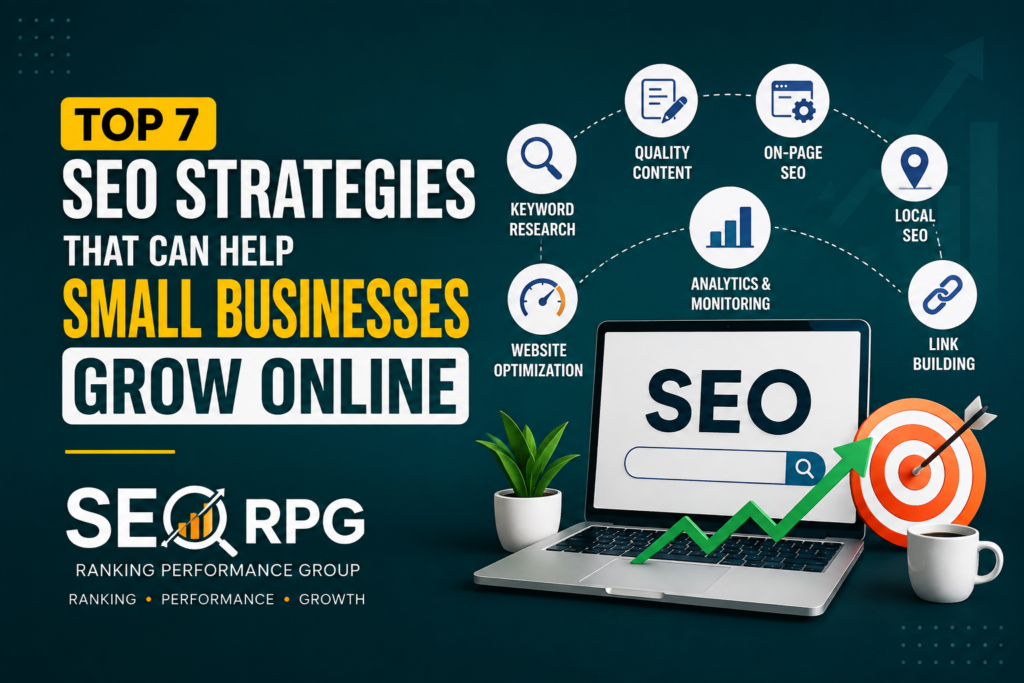
The top 7 SEO strategies for small businesses include keyword research, on-page SEO, local SEO, helpful content creation, website optimization, quality backlink building, and continuous performance tracking.
The most important thing is to focus on your customers rather than search engines alone. When your website provides useful information, solves customer problems, loads quickly, and clearly communicates your services, SEO can support long-term online growth.
If your small business wants to increase organic visibility, attract qualified visitors, and generate more enquiries from Google, building a consistent SEO strategy is a strong place to start.
Ready to improve your online visibility? SEO RPG can help your business build a practical SEO strategy focused on visibility, traffic, and sustainable growth.