

For small businesses, getting found on Google can make a major difference in attracting new customers. But simply having a website is not enough. Your website needs to appear when potential customers search for products, services, or solutions related to your business.
This is where keyword research for small business SEO becomes important.
Choosing the best keywords for small business SEO helps you understand what your target audience is searching for and optimize your website around those search terms. The right SEO keywords can help increase organic traffic, improve Google rankings, attract qualified visitors, and generate more business leads.
In this guide, we will explore 7 powerful ways to find the best keywords for small business SEO and explain how you can use them effectively in your SEO strategy
What Are the Best Keywords for Small Business SEO?
The best keywords for small business SEO are search terms that are highly relevant to your products or services and are used by your potential customers on search engines.
A good keyword is not necessarily the keyword with the highest search volume. Instead, small businesses should consider several factors, including:
- Relevance to the business
- Search intent
- Search volume
- Keyword competition
- Keyword difficulty
- Commercial intent
- Location
- Potential to generate leads or sales
For example, a digital marketing agency may target broad keywords such as “digital marketing.” However, more specific keywords such as “SEO services for small businesses” or “local SEO services in Tamil Nadu” can attract users with stronger buying intent.
Therefore, the right small business SEO keywords should match both your business goals and your customers’ search intent.
Why Is Keyword Research Important for Small Business SEO?
Keyword research is one of the most important parts of a successful small business SEO strategy.
Without proper keyword research, you may create content that nobody searches for or target keywords that are extremely difficult to rank for.
Effective SEO keyword research helps businesses:
- Discover what customers are searching for
- Identify high-intent keywords
- Find relevant long-tail keywords
- Improve website content
- Build better service pages
- Increase organic search visibility
- Attract qualified website traffic
- Generate more leads
- Understand customer search behavior
- Identify new content opportunities
When the right keywords are combined with high-quality content and proper website optimization, they can become a strong foundation for long-term organic growth.
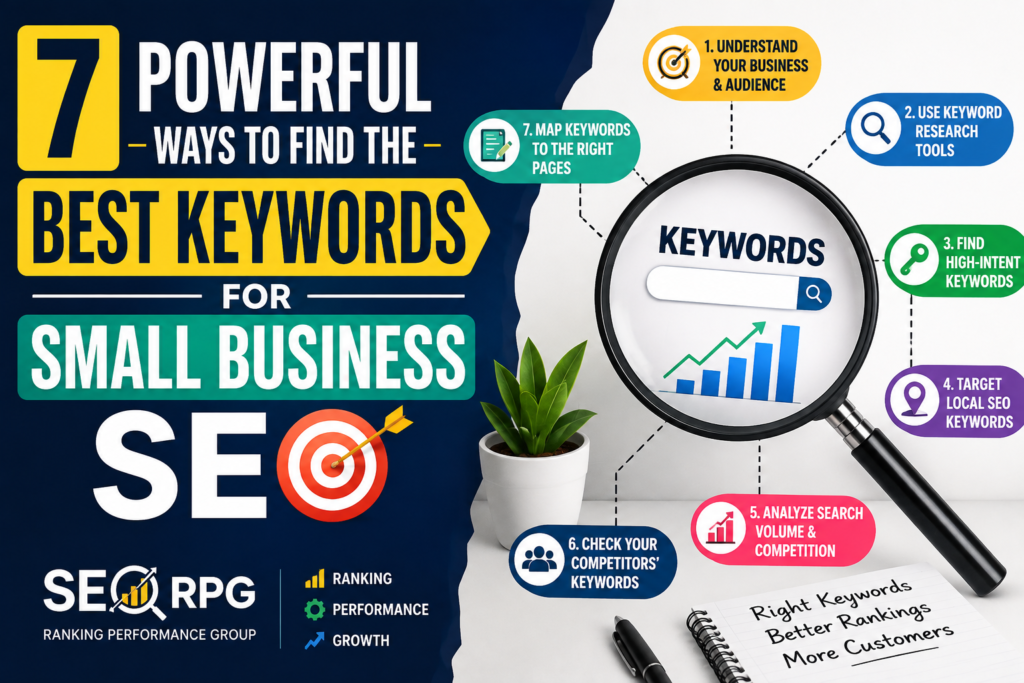
7 Powerful Ways to Find the Best Keywords for Small Business SEO
1. Start With Your Products and Services
The easiest way to begin keyword research for small business SEO is by listing everything your business offers.
Create a list of your main products, services, solutions, and customer problems.
For example, an SEO company could start with keywords such as:
- SEO services
- Local SEO services
- Technical SEO services
- On-page SEO services
- SEO consultant
- SEO company
- SEO services for small businesses
These initial keywords can become your seed keywords.
From these seed keywords, you can discover more specific and valuable search terms using keyword research tools.
Always make sure the keywords you choose are directly connected to your business.
2. Find High-Intent Keywords
Not every search has the same purpose. Understanding search intent is essential when selecting the best SEO keywords.
Search intent generally falls into categories such as informational, navigational, commercial, and transactional intent.
For example:
Informational:
“What is SEO?”
Commercial:
“Best SEO company for small businesses”
Transactional:
“Hire SEO services for small business”
For lead generation, commercial and transactional keywords can be particularly valuable because the searcher may already be considering a product or service.
Small businesses should therefore include a combination of informational and high-intent keywords in their SEO strategy.
3. Use Long-Tail Keywords
Long-tail keywords are longer and more specific search phrases. They usually have a narrower search intent than broad keywords.
Examples include:
- Best SEO company for small businesses
- Affordable SEO services for small businesses
- Local SEO services for small businesses
- SEO services for small businesses in Tamil Nadu
- How to improve Google rankings for a small business website
These long-tail keywords for small businesses can be extremely useful because they target specific customer needs.
Although individual long-tail keywords may have lower search volume, they can attract highly relevant visitors and potentially generate better-quality leads.
For small businesses competing against established websites, long-tail keywords can also provide opportunities to target less competitive search queries.
4. Research Local SEO Keywords
If your business serves a specific city, district, or region, local keywords should be part of your strategy.
Local SEO keywords combine your product or service with a location.
For example:
- SEO company in Madurai
- SEO services in Tamil Nadu
- Digital marketing agency in Madurai
- Local SEO services in Tamil Nadu
- Web development company in Madurai
These location-based keywords can help businesses target customers who are searching for services in a specific geographical area.
You can also identify local search opportunities through your Google Business Profile, customer questions, local competitors, and location-specific searches.
For businesses that depend on local customers, combining local SEO for small businesses with relevant service keywords can significantly strengthen online visibility.
5. Analyze Your Competitors’ Keywords
Competitor keyword research is another powerful way to discover new SEO opportunities.
Identify businesses that are ranking for keywords related to your products or services. Then analyze the topics, service pages, and content that help them attract organic traffic.
Look for opportunities such as:
- Keywords your competitors rank for
- Keywords they are targeting on service pages
- Long-tail keywords they use in blog content
- Local keywords they target
- Questions they answer
- Content gaps on their websites
You do not need to copy your competitors.
Instead, use competitor keyword research to identify gaps and create more useful, comprehensive, and relevant content.
A strong small business SEO strategy combines competitor insights with your own customer and business knowledge.
6. Evaluate Search Volume and Keyword Difficulty
Search volume and keyword difficulty are two important metrics when choosing the best keywords for small business SEO.
Search volume indicates approximately how often people search for a keyword.
Keyword difficulty estimates how challenging it may be to rank for that keyword, depending on the tool being used.
A keyword with extremely high search volume may look attractive, but it can also have strong competition.
For example, ranking for a broad keyword such as “SEO” may be difficult for a new small business website.
A more specific keyword such as “SEO services for small businesses” may provide a more realistic opportunity.
The ideal keyword selection depends on your website authority, competition, location, industry, and business objectives.
7. Map Keywords to the Right Website Pages
Finding keywords is only the first step. You also need to use them strategically.
Create a keyword map that connects specific keywords with relevant website pages.
For example:
Homepage:
Digital Marketing Agency
SEO Service Page:
SEO Services
Local SEO Page:
Local SEO Services
Small Business SEO Page:
SEO Services for Small Businesses
Blog:
How to Improve Google Rankings for Small Businesses
This prevents multiple pages from competing against each other for the same primary keyword.
Use your target keywords naturally in:
- Page titles
- H1 headings
- H2 and H3 headings
- Introduction
- Body content
- Meta descriptions
- URLs
- Image alt text
- Internal links
Avoid forcing keywords into every sentence. Google and users both benefit from clear, natural, helpful content.
How to Choose the Right Small Business SEO Keywords
When selecting SEO keywords for small businesses, consider the following checklist:
Relevance
Does the keyword accurately describe your product, service, or solution?
Search Intent
Does the keyword match what your potential customer wants?
Competition
Can your website realistically compete for this keyword?
Search Volume
Are enough people searching for the keyword to make it worthwhile?
Business Value
Can ranking for the keyword potentially generate leads, enquiries, or sales?
Location
If you serve a specific area, does the keyword include relevant local intent?
A keyword with moderate search volume but strong commercial intent can sometimes be more valuable than a high-volume keyword with little business value.
Common Keyword Research Mistakes Small Businesses Should Avoid
Many businesses make keyword research mistakes that can limit their SEO performance.
Avoid:
- Choosing keywords only because they have high search volume
- Targeting extremely competitive keywords without a strategy
- Ignoring search intent
- Forgetting local keywords
- Using irrelevant keywords
- Keyword stuffing
- Creating multiple pages targeting the same keyword
- Ignoring long-tail keywords
- Not researching competitors
- Failing to update keyword strategies over time
Successful SEO requires continuous research, content optimization, and performance monitoring.
Final Thoughts
Finding the best keywords for small business SEO is not about choosing the keywords with the highest search volume. It is about finding search terms that connect your business with the right audience at the right stage of their search journey.
The 7 powerful ways to find the best keywords for small business SEO include starting with your products and services, identifying high-intent keywords, using long-tail keywords, researching local SEO keywords, analyzing competitors, evaluating search volume and keyword difficulty, and mapping keywords to the right website pages.
With a well-planned small business SEO strategy, businesses can improve Google rankings, increase organic traffic, attract qualified leads, and build stronger online visibility.
If you want your small business website to compete effectively in search results, start with proper keyword research and build your SEO strategy around keywords that have genuine relevance and business value.
SEO RPG can help businesses develop a focused SEO strategy, keyword research plan, content strategy, local SEO approach, and website optimization process designed to improve online visibility and generate sustainable organic growth.